
NIGERIAN FOLKLORE VILLAGE


NIGERIAN FOLKLORE VILLAGE
POST MORTEM
"A journey back to a home long gone, where only spirits are left in place of memories. "
DESIGN
Some of the strengths I feel were in this project was its initial concept and its scope in execution. I had confidence that I could execute this concept well enough within 10 weeks and I tried to keep the design fairly explicitly stated but also loose enough that if there was anything that needed changed or expanded on composition-wise, it could be easily changed with the modular pieces I made. Some weaknesses I felt associated with this design was that there were more moving pieces to it than I once initially thought. I also realized that it was much tighter in layout than initially designed and in earlier concept I wanted to make the scene a bit more expansive. In hindsight, this set piece is very small.
Unforeseen problems of this design.
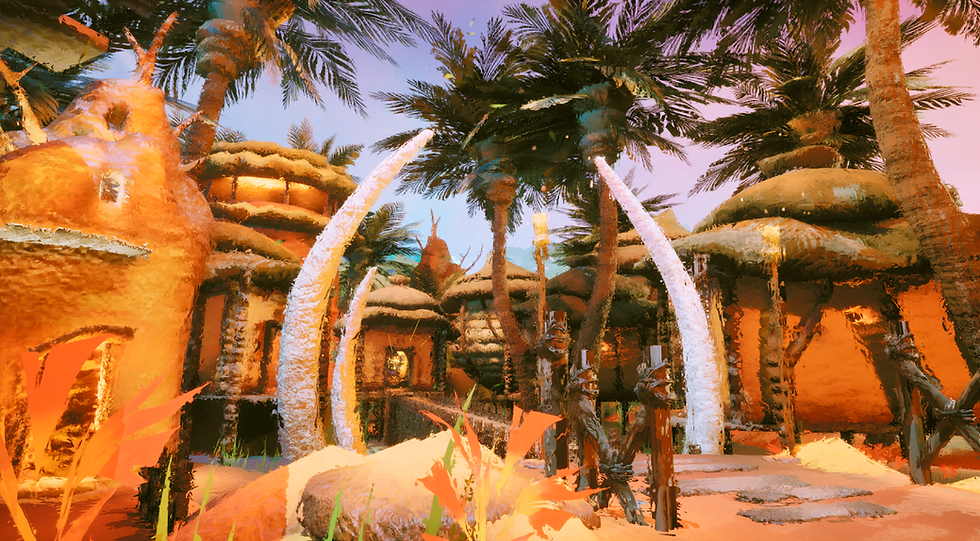
Some unforeseen problems I had with this design was some aspects of style and the level of detail implemented that will realistically never be seen with its post processing effect. A lot of time was put into some finer details that are obscured with the effect. With this projected I wanted to practice with that detail but the style ended up taking priority.
What I could have done differently.
I would have tried to play around a bit more with the constraints of the post processing effect. I would have made it less strong along the player path and stronger from a distance for the painting illusion to be a bit stronger but overall I'm not unhappy with it.
SCOPE
I would say the scope was very doable, with 10 weeks I was able to do more than I thought I was going to around week 5. I was able to easily take feedback and critique and apply it where it was suggested with the time given and the space I had in the environment.
PLANNING
I'd like to believe I planned this well, at the very least, better than previous environments I've made. I tried to keep all of my references and my folders and files for this project fairly organized and I kept a close eye on my timeframe for what I could do in that amount of time without making sacrifices to my health and if I fell behind I made an effort to put in extra work on the next sprint if so. This environment and project introduced me to a more organized workflow that I will hopefully continue to grow in the future.
EXECUTION/TESTING
I always try to pull inspiration from games I love, but a lot of the games I enjoy are very hyper realistic and when I tried to execute that style I find myself disappointed because I'm still learning and it won't appear exactly how I picture it. I can be a perfectionist a lot of the time so I tend to focus on minor things or details when working on any art piece. When given a style to work with, I found that it was much easier to create work I'm happy with and feel excited to keep working on it. I was able to figure out a lot of new techniques in modeling and texturing, along with in-engine features for Unreal and Maya that helped me create a cohesive style that I could keep in tandem with my perfectionism. The more I told myself it didn't need to be perfect because it's a style, I found that there a different version of perfection in embracing a style that surpasses fine details and graphical feats. It made it fun to do!
SUPPORT
Whenever I reached a low point in the quarter, I usually try to keep those feelings to myself and keep moving forward. I was taught that its okay to feel disappointed or frustrated but you can't stay there. So I would keep going through every day trying to do what I could even if it wasn't amazing or awesome. It was something! Sometimes it can be hard to convince myself that my best is enough, and when that happens I talk to my friends, family and peers to try to remind myself that life is okay and it keeps moving forward, you just have to move with it.
COMMUNICATION
Despite doing everything in-engine on my own, no one truly does anything completely alone. I was able to receive feedback from my peers, professor, and outside contributors and visual testers like friends from other majors who gave critiques and suggestions that I did my best to implement.
LEARNINGS
• Improved workflow practice.
• Improved documentation.
• Scope management.
• Maya workflow and techniques.
• Unreal Engine optimization.
• Particle and Niagara effects.
• Post Processing effects.
• Unreal landscaping.
• Time management.
• Environmental storytelling and implementation.
• Project presentation.
• Stand-up/Daily SCRUM Project organization.
• Maya sculpting tools.

TRAILER
DEMO REEL
MASK CONCEPTUAL DESIGNS
.png)
.png)
.png)

.png)
.png)
MASK 3D MODELS

ENVIRONMENT LAYOUT
POST - PROCESSING
EXPERIMENTATION
PAINTING POST PROCESS EFFECT
YOUTUBE | BLUEPRINT USED
The effect that I wanted to give this environment, an oil painting look, required a post process effect that wouldn't just effect the player camera/viewport but the world and materials of objects as a whole. The post processes on marketplace weren't really looking like what I wanted so to do this, I used a tutorial to make this effect adjustable and customizable while understanding how it works. The blueprint required to make this effect work is to use a normal map as a world aligned texture that will be linked to a scene texture post process input. Then creating parameters for the material instance created from the post process material to be able to slide the variables like the effects intensity, scale, and saturation. This effect places a normal map across the world like a layer, so anything within the post processing volume will be within the tiling range of this normal map. So when intensity and or scale are adjusted, it changes the world align on the world's UV and distorts it. This gives the world, not just the viewport of the player, a "painted" look. If I were to go back and make any adjustments to this effect, I would change its intensity to give it a less grainy effect.


BLUEPRINT LAYOUT
MATERIAL NORMAL MAP EFFECT